- 0
- 879 words
Retained solar equipment gives a retrofit a starting arrangement that already has electrical connections and operating responsibilities. Adding storage or new dispatch functions changes some of those relationships while leaving others in service. A commercial hybrid inverter enters that project as an addition to identified assets, rather than the centre of an installation designed from an empty site. The first design question is which existing interfaces the upgrade must preserve.
Establishing What Remains in Service
The retained PV converter, battery equipment and distribution board each supply different information to the upgrade. Their model identities locate the relevant ratings and interface documentation. An installation drawing then shows where those devices connect, separating hardware that stays from connections or control duties that the project proposes to change.
Existing battery capacity describes stored energy, while its operating-voltage window and current limits describe electrical acceptance. Those records concern the actual retained battery, including its configuration, rather than a nominally similar replacement considered during an earlier design.
Its management interface adds the conditions under which charging and discharging are permitted. Replacing an existing controller can change which device issues charge permissions, even when the retained battery hardware and connections remain untouched.
A commercial hybrid inverter proposed for this arrangement has to meet those inherited interfaces alongside the intended new duty. An available connection is not necessarily an unused connection: an existing controller, protective device or supply assignment may already depend on it. The retained arrangement therefore needs a functional record as well as an equipment inventory.
Keeping Solar Conversion on the AC Side
Retaining a grid-connected PV converter places its solar contribution on the AC side of the proposed storage arrangement. The battery converter exchanges power across its own DC and AC interfaces. The two paths meet within the electrical installation, while their operating permissions and coordination still require an agreed arrangement.
The existing solar converter continues to perform its assigned conversion task. A proposed storage discharge changes the contribution drawn from other sources, and charging adds another demand at the relevant connection. An operating schedule can describe those movements together, using the same connection boundary for solar production, site consumption and battery exchange.
An outage creates a separate coordination case from ordinary grid-connected operation. The retrofit description needs to identify which equipment establishes the supply reference, which circuits remain connected and how the retained PV converter behaves in that state. AC coupling describes a connection relationship; the configured equipment determines the operating sequence after utility supply disappears.
This route also leaves PV-side and battery-side decisions distinguishable. Retaining an existing AC converter differs from routing new PV strings through an external DC/DC controller. A project containing both paths can name each one explicitly, preserving the original solar conversion duty while assigning new equipment its particular input and output connections.
An Interface Provision Within an Integrated Assembly
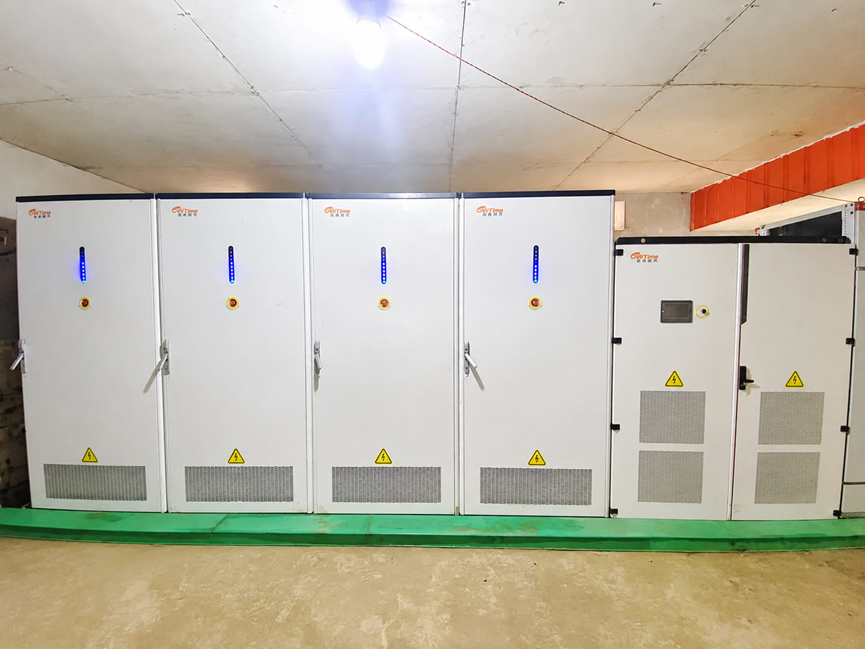
AC coupling with mainstream grid-connected PV inverters is supported within the four-in-one inverter family from GWTime. Interfaces for third-party BMS and battery systems provide another integration provision. Those two provisions address different retained assets, making the existing converter identity and battery documentation relevant to the proposed equipment combination.
PCS, EMS, ATS/generator control and distribution share the inverter assembly, while MPPT equipment remains separate on the PV side. Integrated distribution includes protection, bypass and auxiliary power functions. The retrofit drawing can locate these supplied functions against duties already performed by the existing installation and identify which external connections change.
Battery matching in the GWP125-G01 and GWP250-G01 retains a 680-950 V DC full-load range within a 1000 V maximum input specification. The AC arrangement is 3/N/PE, 230/400 V at 50/60 Hz. These fields give the inherited electrical records concrete equipment references without replacing the battery’s complete operating window.
PCS integration with the outdoor battery-cabinet family needs both completed engineering integration and the necessary communications protocol shared by the third-party converter supplier. Those conditions concern the named cabinet and converter combination. A retrofit using that battery family can record the protocol supplier and engineering scope beside the converter identity, leaving the integration work traceable.
Giving the Retained Installation a New Operating Assignment
Export control, backup and increased local solar use set different acceptance questions for the upgraded arrangement. The relevant measurements and operating sequence depend on which objective is assigned to the commercial hybrid inverter. The same retained hardware can face different control requirements as the proposed objective changes.
Independent reverse-power control on each AC phase is part of the GWTime four-in-one family, with an anti-backflow response below 800 ms. Its on/off-grid transfer below 20 ms describes another function. A retrofit specification keeps the intended export-control response separate from the change of supply experienced by retained loads.
The BMS within GWTime battery cabinets forms part of the supplied storage system rather than an independently sold component. Retaining another battery therefore keeps its own management interface in the upgrade record. Responsibility for that interface remains identifiable when the new equipment and operating settings are introduced.
The completed arrangement can be checked against the assets originally designated for retention. Its drawings, interface records and operating sequence should still describe those devices in their revised roles. Each retained converter, battery and distribution section needs an assigned duty, with changed connections carrying the new power and control relationships introduced by the retrofit project.
Author

helloemail204-210@gmail.com